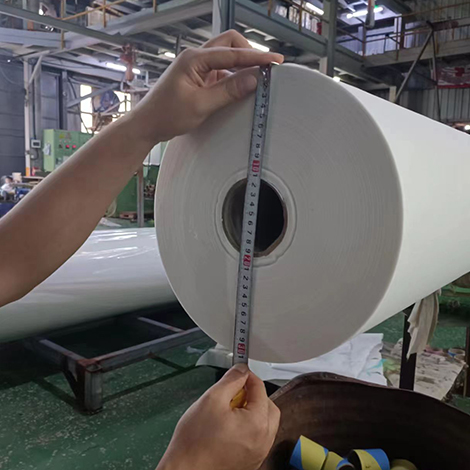

When choosing polypropylene non-woven fabric, the process selection directly affects the waterproof effect, service life, and construction efficiency - spunbond and needle punching are just the starting points, what really affects the decision is what problem you use it to solve.
1、 Why does the process selection of polypropylene non-woven fabric directly affect its service life?
In waterproof engineering and filtration scenarios, the core value of polypropylene non-woven fabric comes from the characteristics of polypropylene fibers: acid and alkali resistance, microbial resistance, and non water absorption. But different processes can amplify or weaken these advantages:
Spunbond process: After high-temperature melt spinning, it is directly formed into a web with strong fiber continuity, which is more suitable for reservoir reinforcement and roadbed isolation that require high tensile strength
Acupuncture process: By mechanical puncture, fibers are entangled, resulting in higher porosity and better performance in drainage and filtration scenarios
A common misconception in practical engineering is to consider weight as the sole criterion, but in fact, thickness deviation and fiber orientation are the main causes of water leakage. For example, when 0.5mm thick spunbond polypropylene non-woven fabric is used for bridge deck waterproofing, its longitudinal fracture strength is often 30% higher than its transverse strength.
2、 What is the essential difference between spunbond and needle punching processes?
The essential difference between the two mainstream processes lies in the fiber bonding method, which directly determines three key properties:
Intensity performance
Spunbond: Fiber fusion bonding, more balanced tensile strength
Acupuncture: Fiber physical entanglement, more prominent bursting strength
pore structure
Spunbond: uniform pore size but poor breathability
Needle punched non-woven fabric: three-dimensional pore structure, suitable for scenarios that require bidirectional filtration
weather resistance
Spunbond: UV resistant additives are easier to mix evenly
Acupuncture: Surface fluff may pulverize after long-term exposure to sunlight
Special processes such as spunlace non-woven fabric, although softer, have higher costs and are generally used in the medical field.
3、 Comparison Table of Process Selection in Four Common Scenarios
Preferred process key parameters for the scene; alternative
Building waterproof spunbond longitudinal fracture strength ≥ 8kN/m; reunite with. ..
Medical packaging spunbond/water jet weight 30-50g/㎡; Melt blown non-woven fabric
Agricultural plastic film needle punching thickness ≥ 1.2mm; short fiber hot-rolled non-woven fabric
Industrial filtration needle hole size 10-100 μ m; PP non-woven fabric
*Detailed explanation of building waterproofing scenarios
It is recommended to use polypropylene non-woven waterproof roll with cement adhesive bonding, as the flatness advantage of the spunbond process is obvious. Note that an additional 20cm overlap should be made at the joint of the roll material, and bubbles should be removed using a pressure roller.
4、 What should I prepare after buying polypropylene non-woven fabric?
The most easily overlooked aspect of the construction process is the secondary processing equipment for materials
Cutting accuracy: The roadbed engineering requires an error of ≤ 2mm, and the servo motor configuration of the non-woven fabric cutting machine directly affects the loss rate
Composite efficiency: The production of waterproof rolls requires the hot pressing temperature of the non-woven fabric composite machine to be stable at 160 ± 5 ℃.

Soclal sharing


E-mail : marketing@henghuanonwoven.com
Add : No.260 Liqi Road Hangcheng Street, Changle District, Fuzhou City, Fujian Province, China
Copyright @ 2026 Fuzhou Heng Hua New Material Co., Ltd. All Rights Reserved.  Network Supported
leave a message
Scan to Wechat :

Scan to WhatsApp :