
The excellent performance of PP spunbond nonwoven fabric cannot be achieved without its mature and efficient production process. From ordinary polypropylene particles to the functional fabric rolls we see in our daily lives, the entire process integrates the technical essence of chemical and textile industries. Understanding its production process helps us gain a deeper understanding of the value of this material.
The production of PP spunbond nonwoven fabric begins with raw material preparation. The main raw material is polypropylene resin chip. As required, appropriate color masterbatch or functional additives will be added to change the color of the product or give it special properties such as anti-aging and anti-static.
The core process step of PP spunbond nonwoven fabric is spinning into a web. At present, spunbond method is the mainstream technology for manufacturing PP non-woven fabrics. The principle is to melt polypropylene particles at high temperature, and the melt is extruded through a spinneret to form continuous filaments. These slender filaments are cooled and solidified under the stretching effect of high-speed airflow, and then evenly laid on the moving mesh curtain to form a fluffy web. This process determines the basic weight and uniformity of non-woven fabric.
After the formation of PP spunbond nonwoven fabric web, it needs to be reinforced to form sufficient strength. There are various reinforcement methods, among which hot rolling reinforcement is widely used. The fiber web is formed by a pair of heated rolling rolls, where the contact points between fibers are thermally fused and bonded at specific temperatures and pressures, resulting in a sturdy fabric like material. Another common method is acupuncture reinforcement, which repeatedly punctures the fiber network with thousands of needles with inverted spikes, causing the fibers to entangle and embrace each other.
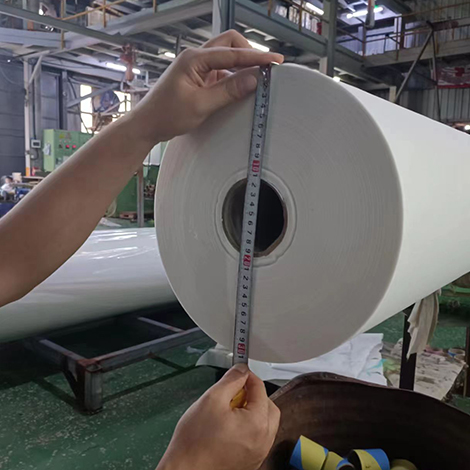
Finally, there is the post sorting and coiling process. According to customer requirements, the produced PP non-woven fabric base may require deep processing such as printing, coating, and lamination. After completing all processes, the finished product is rolled into standard width and length fabric rolls using precision winding equipment. After passing inspection, it can be packaged and shipped out of the factory.
The entire production process of PP spunbond nonwoven fabric has the characteristics of short process, high output, and strong variability. It can flexibly adjust process parameters according to the different needs of downstream markets, and produce various specifications of products from ultra-thin to thick, from soft to stiff, meeting the diverse requirements of medical, hygiene, filtration, packaging and other fields.
Our company's product recommendations:

Soclal sharing


E-mail : marketing@henghuanonwoven.com
Add : No.260 Liqi Road Hangcheng Street, Changle District, Fuzhou City, Fujian Province, China
Copyright @ 2026 Fuzhou Heng Hua New Material Co., Ltd. All Rights Reserved.  Network Supported
leave a message
Scan to Wechat :

Scan to WhatsApp :