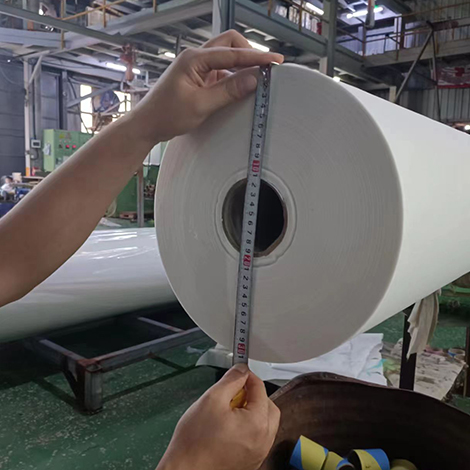

The core reason for the occurrence of cracks in PP spunbond nonwoven fabric during production is uneven material shrinkage or excessive internal stress, which requires systematic adjustment from three aspects: raw materials, processes, and molds.
1、 Adjustment of raw material issues
1. High moisture content of raw materials: PP material has strong water absorption and needs to be dried at 80-100 ℃ for 2-4 hours before use to reduce the moisture content to below 0.05%.
2. High proportion of raw material recycling: After multiple processing, the molecular chains of the recycled material break and the strength decreases. It is recommended that the proportion of new materials should not be less than 70%, and important structural components should use 100% new materials.
3. Mismatch of raw material grades: High flow grades (such as MFR>30) have greater molding shrinkage and are prone to stress. The medium low flow grade (MFR 10-25) should be selected based on the product wall thickness.
2、 Adjustment of Injection Molding Process Parameters
1. Melt temperature: If the temperature is too low, plasticization will be poor, and if it is too high, degradation will occur. PP material is generally controlled at 200-240 ℃, and the optimal value can be determined through mold flow analysis.
2. Injection speed: If the speed is too fast, it will cause shear overheating, and if it is too slow, the temperature of the melt front will be too low. It is recommended to use slow fast slow multi-stage injection and reduce the filling speed at the end.
3. Holding pressure and time: Insufficient holding pressure can cause shrinkage and depression, while excessive holding pressure can generate internal stress. The holding pressure is generally 60-80% of the injection pressure, and the time increases with wall thickness (usually 10-30 seconds).
4. Cooling time: Crystallization of PP material takes time, and insufficient cooling can lead to deformation. The cooling time can be estimated at 1.5-2.5 times the wall thickness (unit: seconds/millimeter).
5. Mold temperature control: If the mold temperature is too low (80 ℃), the cycle will be extended. Suggest setting the mold temperature between 50-80 ℃.
3、 Mold structure improvement
1. Gate design: Small gates will increase shear stress. It is recommended to increase the gate size or use fan-shaped/recessed gates instead.
2. Cooling system: Check if the water circuit is blocked, ensure even mold temperature (temperature difference<5 ℃), and strengthen cooling especially in areas with sudden changes in adhesive thickness.
3. Demoulding system: Improper positioning or insufficient inclination of the ejector pin can cause ejector stress, increasing the demoulding inclination (recommended 1-1.5 ° for PP materials) and the number of ejector pins.
4. Exhaust design: Trapped air can cause burning and insufficient filling. Install an exhaust groove (depth 0.02-0.03mm) at the end of the melt.
4、 Product design optimization
1. Uniform wall thickness: Stress concentration is prone to occur at sudden changes in wall thickness. It is recommended that the variation in adhesive thickness should not exceed 1:1.5.
2. Rounded corner design: All sharp corners should be changed to rounded corners, and it is recommended that the inner rounded corner radius be ≥ 0.5 times the wall thickness.
Suggestion for adjusting the order: First confirm the dryness and grade of the raw materials, then optimize the injection molding process parameters (especially pressure holding and cooling), and finally check the mold and product structure.

Soclal sharing


E-mail : marketing@henghuanonwoven.com
Add : No.260 Liqi Road Hangcheng Street, Changle District, Fuzhou City, Fujian Province, China
Copyright @ 2026 Fuzhou Heng Hua New Material Co., Ltd. All Rights Reserved.  Network Supported
leave a message
Scan to Wechat :

Scan to WhatsApp :