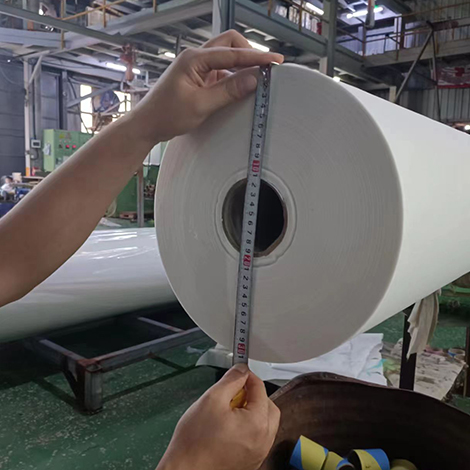

When you think of medical textiles, your mind might go to cotton gauze or surgical steel. But walk through any hospital today, and you will be surrounded by a material you likely cannot see clearly—spunbond nonwoven fabric, specifically made from polypropylene (PP).
From the moment you enter an operating room to the disposal of a single-use gown, spunbond fabric is quietly performing critical tasks that woven textiles simply cannot match.
But why has this material become the gold standard for medical and hygiene applications? Let's explore.
Healthcare providers face a unique dilemma. They need materials that are sterile, protective, and disposable, yet also cost-effective and environmentally conscious (through efficient incineration or recycling). Traditional woven cotton fails here—it absorbs fluids (breeding grounds for bacteria), sheds lint, and is expensive to sterilize repeatedly.
Spunbond nonwoven fabric solves all of these problems.
Our polypropylene spunbond nonwoven is engineered specifically for medical environments. Here's what makes it indispensable:
Bacterial Barrier
Unlike woven fabrics with visible pores, spunbond fabric has a random fiber matrix that blocks microbial penetration. When used in surgical drapes and gowns, it dramatically reduces post-operative infection risks.
Fluid Repellency (Hydrophobic)
Polypropylene naturally repels water and blood. This is critical in operating rooms where fluid strike-through can transfer pathogens from patient to surgeon. For applications requiring absorption (like wound dressings), we can easily treat the surface to make it hydrophilic.
Lint-Free & Low Particulate
Cotton sheds fibers that can fall into open incisions or clog HVAC filters in cleanrooms. Spunbond fabric is thermally bonded—no adhesives, no loose fibers. This makes it ideal for sterile packaging and pharmaceutical cleanrooms.
Breathable Yet Protective
While blocking fluids and bacteria, spunbond allows air and water vapor to pass through. Surgeons wearing spunbond gowns stay cooler and more comfortable during long procedures compared to impervious plastic alternatives.
Cost-Effective Disposability
Sterilization (using ethylene oxide or gamma radiation) is straightforward and inexpensive. After single use, the fabric can be incinerated cleanly, as polypropylene contains no halogens or heavy metals.
Here is where you will find our spunbond fabric in action:
| Application | Why Spunbond? |
|---|---|
| Surgical masks | Filters particles; lightweight and comfortable |
| Isolation gowns | Fluid barrier; breathable; tear-resistant |
| Surgical drapes & packs | Sterile field protection; lint-free |
| Wound dressings | Can be treated for absorption; non-adherent options available |
| Sterile packaging | Breathable seal; withstands gamma sterilization |
| Diapers & sanitary napkins | Soft top sheet (treated hydrophilic) and fluid barrier back sheet |
| Wet wipes | Strong when wet; lint-free; chemically inert |
| Medical mattress covers | Fluid-proof; reduces cross-contamination |
The pandemic highlighted just how vital spunbond nonwoven fabric is. When the world needed billions of masks and gowns overnight, polypropylene spunbond was the only material that could be scaled quickly, cost-effectively, and reliably.
Factories that once made shopping bags pivoted to producing medical-grade protective equipment because the underlying material—polypropylene spunbond—is fundamentally the same. Only the specifications (GSM, width, additive package) change.
Not all spunbond fabric is suitable for medical use. At [Your Company Name], our medical-grade spunbond meets strict standards:
Basis weight: 10 to 100 GSM (typical medical gowns: 30–50 GSM; masks: 20–25 GSM)
Hydrostatic head resistance: Verified fluid barrier performance
Bacterial filtration efficiency (BFE): Tested for mask and drape applications
UV stability: Not required for indoor medical use, but we offer sterile-grade packaging
Additives: Antioxidants and processing aids only—no toxic stabilizers
The next time you see a surgeon in an operating room or open a sterile bandage, remember: behind that simple white fabric is decades of materials science.
Spunbond nonwoven fabric—made from polypropylene—has redefined what healthcare textiles can do.
It protects patients. It protects providers. And it does so at a cost that makes single-use sterility possible for everyone.
Looking for medical-grade spunbond nonwoven fabric? HENGHUA Nonwoven produces certified, customizable PP spunbond for hygiene and healthcare applications worldwide.
Contact us for technical data sheets, samples, or a quotation.

Soclal sharing


E-mail : marketing@henghuanonwoven.com
Add : No.260 Liqi Road Hangcheng Street, Changle District, Fuzhou City, Fujian Province, China
Copyright @ 2026 Fuzhou Heng Hua New Material Co., Ltd. All Rights Reserved.  Network Supported
leave a message
Scan to Wechat :

Scan to WhatsApp :