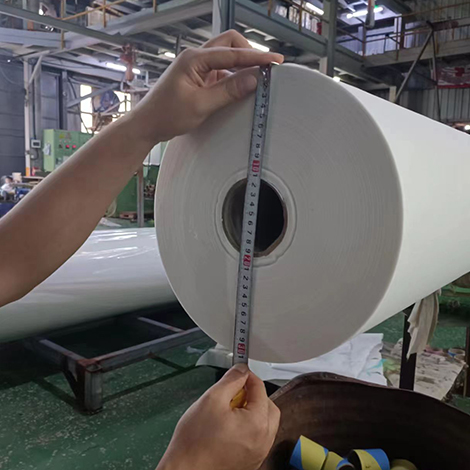

The addition of calcium carbonate filling masterbatch in the production process of PP (polypropylene) spunbond nonwoven fabric gives it more advantages in terms of price, processing process, production cost, physical indicators, etc. Greatly expanding the application areas and sustainable development of PP spunbond nonwoven fabrics, energy conservation and emission reduction are inevitable trends in the development of the spunbond nonwoven fabric industry. Today we will introduce the process and application of calcium carbonate in non-woven fabrics!
Manufacturing process of calcium carbonate in PP spunbond nonwoven fabric
The raw material used in the production of PP spunbond nonwoven fabric is high melt index polypropylene, which is mixed evenly with calcium carbonate filled masterbatch. It enters the screw extruder from the hopper for extrusion melting, then enters the continuous pre filter, and finally enters the spinning box. The melt enters the spinning head through a metering pump, and is accurately measured by the metering pump to be quantitatively transported to the spinning plate, where it forms a continuous fine flow of melt through the spinning holes, namely the primary fibers. The newborn fibers are further cooled by sudden cold air and stretched by airflow to form long bundles. The long filament bundle is oscillated back and forth by the spinning roller, and evenly laid on the running mesh curtain to form a fiber web.
Why choose calcium carbonate as the filling masterbatch?
Calcium carbonate is an extremely important inorganic chemical product widely used in industries such as plastics, rubber, coatings, and papermaking. The characteristics of several commonly used fillers in industry are as follows:
Calcium carbonate: The purpose of adding filler masterbatch to spunbond nonwoven fabric is to reduce costs. From the experience of modifying plastic resin functions and reducing costs, it is the most affordable and readily available, with a white and odorless powder appearance. The relative density is 2.71, the refractive index is 1.65, and the Mohs hardness is 3.
Elderly soil: easy to disperse, relatively more expensive than calcium carbonate, also white in appearance, with a relative density of 2.6 and a refractive index of 1.56.
Talc powder: easy to disperse, has certain lubricity to equipment during processing, and is a white powder with solid crystals. I want a density between 2.7 and 2.8, but the price is relatively expensive.
Mica powder: The relative whiteness is lower. Due to its non-toxic nature, mica powder can be used in food contact products with a relative density between 2.8 and 3.0, a refractive index of 1.59, and a Mohs hardness of 3.
Wollastonite: with a relative density of 2.9, a refractive index of 1.63, and a Mohs hardness of 4.5, its greatest advantage is that it does not absorb moisture and has little effect on the color masterbatch.
Therefore, in the production process of non-woven fabrics, calcium carbonate is generally chosen as the main filler, and a small amount of kaolin or wollastonite is added appropriately to increase dispersion and transparency during the production process. Generally, calcium carbonate with a mesh size of 1500 or above is chosen, and it cannot be too fine because a mesh size that is too fine is expensive. In addition, ultrafine powders generally cannot be dispersed.
Filling method of filling material
Without changing the production equipment and process conditions, the filling material is added to the feeding hopper of the color masterbatch, but the addition ratio will also be limited as a result. Some manufacturers add a larger hopper and feeder specifically for adding fillers. The maximum amount of granular material added is about 20%, and the amount of powder added is about 8%. And now some manufacturers have added one or several mixing machines to mix these materials evenly and manually feed them into the hopper, which is relatively more uniform. The addition ratio can reach up to 30%, and the powder can also reach about 15%. Some manufacturers mix it evenly and then suck it into the hopper, but the uniformity is relatively poor, but it can also be added to 20% to 30%.
Due to the cost reduction of filling masterbatch, the higher the concentration of filler in the filling masterbatch, the lower the cost, and the user addition ratio is relatively small. On the contrary, the lower the concentration, the higher the cost, and the higher the proportion of users adding. And the production functional masterbatch cannot be filled with masterbatch to avoid affecting its functionality.
Although using calcium carbonate as a filling masterbatch can increase the yield of non-woven fabrics and reduce costs, the non-woven fabrics produced by this method have poor tear resistance and are highly susceptible to wear during use. To improve this drawback,
The precautions for using filling masterbatch are as follows:
1. Production functional masterbatch cannot be filled with filler masterbatch to avoid affecting its functionality. Fillers have a hindering effect on some functional agents, but have no effect on color.
2. Filling masterbatch has a certain degradation effect, which affects the lifespan of non-woven fabrics, especially for non-woven fabrics produced from powder materials.
3. The testing standards for this product include:
GW∝-2000 Standard for Control of Municipal Solid Waste Incineration
GB 3682 Melt Flow Rate
Q/TNGM 01-2006 Test Method for Pressure Rise Index of Polypropylene Fiber Color Masterbatch
GB 1033 Test Method for Density of Filling Masterbatch
GB 2913 Whiteness Test
4. Filling masterbatch is not easy to store in the air for a long time, and its moisture absorption is strong, which can affect its spinnability. If used irregularly, vacuum packaging can be chosen to fill masterbatch.

Soclal sharing


E-mail : marketing@henghuanonwoven.com
Add : No.260 Liqi Road Hangcheng Street, Changle District, Fuzhou City, Fujian Province, China
Copyright @ 2026 Fuzhou Heng Hua New Material Co., Ltd. All Rights Reserved.  Network Supported
leave a message
Scan to Wechat :

Scan to WhatsApp :