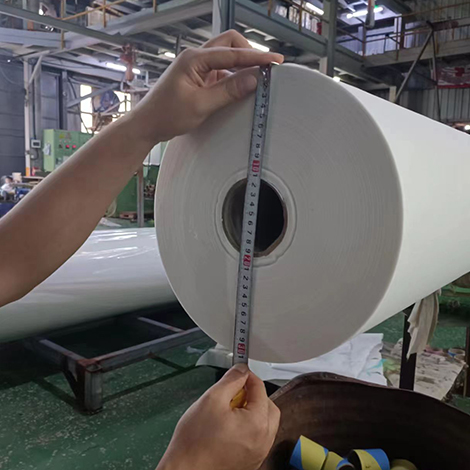
What core tube size should your rolls have?
Jun 29, 2026
You've chosen the right fabric. The right GSM. The right width. The right color. But there's one more detail that matters — and it's often overlooked: What core tube size should your rolls have?
It seems like a small detail. But choosing the wrong core size can affect shipping costs, production efficiency, and even fabric quality.
Here's everything you need to know about selecting the right roll core tube for your PP spunbond nonwoven fabric.
What Is a Roll Core Tube?
A roll core tube (also called a paper core or cardboard core) is the cylindrical center around which nonwoven fabric is wound. It provides structural support to the roll and allows the fabric to be mounted on dispensing or converting equipment.
Core tubes are typically made of high-density kraft paper — strong enough to support the roll weight during winding, handling, and shipping.
The Three Standard Core Sizes
In the nonwoven industry, there are three standard inner diameters you need to know:
Core SizeInner Diameter (ID)How It Is Produced
3-inch core
76.2 mm
Standard initial core — directly from the production line
2-inch core
50.8 mm
Requires rewinding (converted from 3-inch)
1.5-inch core
38.1 mm
Requires rewinding (converted from 3-inch)
3-Inch Core — The Industry Standard
The 3-inch core is the most common size in the nonwoven industry. At Heng Hua Nonwoven, like most manufacturers, our production line produces fabric directly onto 3-inch cores. This is the "initial" or "primary" core — no extra steps, no additional handling, just straight from the line.
Why 3-inch is the standard:
Directly compatible with most nonwoven production lines
Fits most converting equipment (bag making, mask machines, slitting lines)
Strong enough for typical roll weights
Cost-effective — no additional rewinding step required
Lowest risk of quality issues
2-Inch and 1.5-Inch Cores — Rewinding Required
Some customers request smaller cores — 2-inch or 1.5-inch — to reduce roll size. But unlike 3-inch, these are not produced directly on the main production line. They require a rewinding process (also called "slitting and rewinding" or simply "rewind").
In rewinding, a large 3-inch core roll is unwound, then rewound onto a smaller core. This adds an extra production step, which means:
Higher cost — additional labor and machine time
Longer lead time — rewinding takes time
Potential quality risk — fabric is handled twice
Why Choose a Smaller Core? The Container Advantage
The main reason customers ask for 2-inch or 1.5-inch cores is shipping efficiency.
A smaller core diameter means the overall roll diameter is smaller for the same roll length. Even a 1–2 cm reduction in roll diameter can make a significant difference — it might mean fitting one extra row of rolls when laid horizontally inside a shipping container.
Over a full container load, that one extra row translates to real freight savings. For high-volume buyers, this is a compelling reason to consider smaller cores.
Critical Rule 1: GSM Limits for Rewinding
Important: For fabrics of 40gsm or lighter, we do not recommend rewinding. For 30gsm and below, rewinding is strongly discouraged.
Why? Because lightweight nonwoven fabric is thin and delicate. The rewinding process subjects the fabric to tension, stretching, and mechanical handling. For light fabrics, this can cause:
Thinning — the fabric stretches and becomes even lighter, changing the GSM
Deformation — width shrinkage or uneven edges
Surface damage — pilling, abrasion, or fiber disturbance
Loss of uniformity — inconsistent GSM across the roll
Rule of thumb:
30gsm and below: MUST use 3-inch core. Rewinding will damage the fabric.
40gsm: Rewinding is risky — evaluate carefully.
50gsm and above: Rewinding is generally safe with proper tension control.
Critical Rule 2: Width Limits for Rewinding
Rewinding is not just about GSM — fabric width matters just as much.
Our rewinding machines have specific width capabilities. If a roll is too narrow, it cannot be rewound properly because the fabric will drift, shift, or wind unevenly.
Our rewinding machine specifications:
Rewinder 1: 1.6 meters (160 cm) width capacity
Rewinder 2: 2.4 meters (240 cm) width capacity
Width limits for rewinding:
Fabric WidthRewinding Possible?Notes
≥ 140 cm (1.4m)
Yes
Stable rewinding, good edge alignment
130 cm (1.3m) and below
No
Fabric shifts, winds unevenly, edges become crooked
52 cm (0.52m) — too narrow
No
Cannot be rewound on our equipment
Remember: 1.5 meters and 1.4 meters can be rewound. 1.3 meters and below cannot — the fabric will drift and wind crooked.
Real-World Specification Examples
Here are two examples to help you understand when rewinding works and when it doesn't:
✅ Example 1 — Rewinding OK
Specification: 70gsm × 200cm width × 50m lengthRequested core: 2-inchVerdict: ✅ OK
Why: 70gsm is heavy enough to handle rewinding tension. 200cm width is well within the 2.4m rewinder capacity. The fabric is stable, and 50m length is manageable.
✅ Example 2 — Rewinding OK
Specification: 50gsm × 150cm width × 100m lengthRequested core: 1.5-inchVerdict: ✅ OK
Why: 50gsm is above the 40gsm threshold. 150cm width is above the 130cm minimum. The 1.5-inch core is feasible with careful tension control.
❌ Example 3 — Rewinding NOT OK
Specification: 25gsm × 52cm width × 200m lengthRequested core: 2-inchVerdict: ❌ NOT OK
Why: 25gsm is below 40gsm — rewinding will stretch and thin the fabric. 52cm width is far below the 130cm minimum — the fabric will drift and wind crooked. This specification must stay on a 3-inch core.
Decision Guide: Can Your Specification Be Rewound?
Use this quick checklist to determine if your specification is suitable for rewinding to a smaller core:
RequirementMust BeWhy
GSM (fabric weight)
≥ 50gsm (ideally)> 40gsm (minimum)
Below 40gsm, fabric stretches and thins during rewinding
Fabric width
≥ 140cm
Below 130cm, fabric drifts and winds unevenly
Roll length
Depends on GSM and width
Longer rolls require more careful tension control
Core Wall Thickness Matters Too
Regardless of the inner diameter, the wall thickness of the core determines its compression strength. A thin core will crush under heavy roll weight or when clamped by a hydraulic chuck.
Core SizeStandard WallHeavy-Duty Wall
3-inch core
5–6 mm
8–10 mm
2-inch core
5–6 mm
8–10 mm
1.5-inch core
4–5 mm
6–8 mm
For any core size, if your roll weight exceeds 100–120 kg, we recommend upgrading to a heavy-duty wall.
Summary: Core Size Decision Flow
Quick decision guide:
Is your fabric 40gsm or lighter? → Must use 3-inch core. No rewinding.
Is your fabric width 130cm or narrower? → Must use 3-inch core. Cannot rewind.
Is your fabric 50gsm+ and 140cm+ wide? → You can choose 2-inch or 1.5-inch via rewinding.
Do you need maximum container efficiency? → Choose the smallest core that meets the above criteria.
The Bottom Line
Choosing the right core tube size is a balancing act between shipping efficiency and fabric quality — with physical machine limits in between.
The rules are simple:
3-inch is the standard initial core — always works, lowest cost, lowest risk
2-inch and 1.5-inch require rewinding — extra cost and lead time, but improve container utilization
40gsm and below — do NOT rewind. Stay with 3-inch.
130cm width and below — do NOT rewind. Stay with 3-inch.
50gsm+ and 140cm+ — rewinding is feasible; choose 2-inch or 1.5-inch for container savings
If you're unsure whether your specification can be rewound, just ask us. We'll check your GSM, width, and length against our rewinding capabilities and give you a clear recommendation.
Looking for a reliable supplier of PP spunbond nonwoven rolls? We offer 3-inch cores directly from production, and can provide 2-inch or 1.5-inch cores via rewinding for suitable specifications.
Contact us for samples or a quote – Let's find the right core size for your product.







 Network Supported