What is the process of spunbond nonwoven fabric?
Jun 04, 2026
From a Nonwoven Roll Manufacturer to You
Have you ever wondered how a roll of polypropylene spunbond nonwoven fabric is made?
Unlike traditional woven fabrics (which require spinning yarn, then weaving on a loom), spunbond nonwoven is produced in a single, continuous, highly efficient process.
Let's walk through the production line step by step.
Step 1: Raw Material — Polypropylene Resin
Everything starts with 100% virgin polypropylene (PP) resin — small, translucent pellets that look like tiny plastic beads.
These pellets are the same base material used in many plastic products, but for nonwovens, we use a specialized grade with specific melt flow index (MFI) — typically 25–40 g/10min — which ensures proper fiber formation.
Optional additives (UV stabilizers, flame retardants, pigments) are mixed with the resin at this stage.
Step 2: Extrusion — Melting the Resin
The PP pellets are fed into a heated extruder. Inside the extruder, a rotating screw pushes the pellets forward through heated zones — typically 220°C to 260°C (428°F to 500°F).
The pellets melt into a thick, honey-like polymer liquid.
Step 3: Filtration & Metering
The molten polymer passes through a filtration system to remove any contaminants or unmelted particles. Then, a metering pump precisely controls the flow rate to the spinneret — ensuring consistent fabric weight (GSM).
Step 4: Spinning — Creating Continuous Filaments
The molten polymer is forced through a spinneret — a metal plate with hundreds or thousands of tiny holes (typically 0.3–0.6mm diameter).
As the polymer exits the spinneret, it forms continuous liquid filaments. Immediately, high-speed air (quench air) blows onto the filaments to cool them from liquid to solid.
This is the "spun" part of spunbond.
Step 5: Drawing — Stretching the Filaments
After cooling, the solid filaments pass through a high-speed air drawing nozzle. This stretches the filaments to several times their original length, which:
Reduces filament diameter (typically down to 15–35 microns)
Orients polymer molecules along the fiber axis
Increases tensile strength significantly
Step 6: Web Formation — Laying the Filaments Down
The drawn filaments are then laid onto a moving conveyor belt (called a forming wire). A vacuum system underneath the belt pulls the filaments down, creating a uniform, random-laid web.
This random orientation is what gives spunbond its uniform strength in all directions — unlike woven fabric, which tears easily along the weave.
Step 7: Bonding — Fusing the Filaments Together
The random web has no strength yet — the filaments are just loosely resting on each other. Now they need to be bonded.
The web passes through a calender (heated rollers) — typically two rollers:
Embossed roller: Has raised dots or patterns
Smooth roller: Flat surface
Heat and pressure (around 150°C–170°C) partially melt the filaments at the contact points, fusing them together. The result: a strong, cohesive fabric.
This is the "bond" part of spunbond.
Step 8: Surface Treatment (Optional)
Depending on the application, the fabric may receive surface treatments:
Hydrophilic treatment: Makes water-absorbent (for wipes, feminine hygiene, medical absorbent layers)
Antistatic treatment: Reduces static charge
Antibacterial treatment: For medical applications
Step 9: Winding — Rolling Up the Finished Fabric
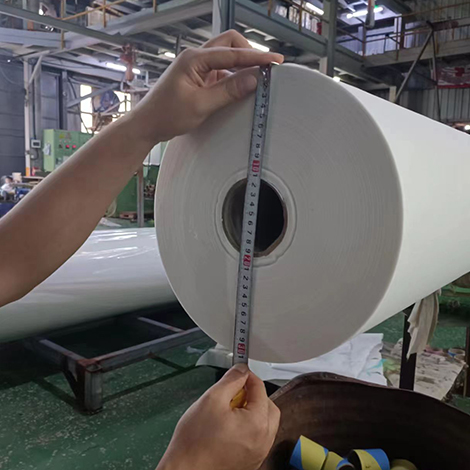
The finished fabric passes through edge trimming (to ensure clean, straight edges), then is wound onto large cardboard cores — typically 3-inch or 6-inch inner diameter.
Roll widths typically range from 1.6m to 3.2m, depending on the production line. Roll lengths vary by GSM and customer requirements.
Step 10: Quality Testing & Packaging
Before shipping, every roll undergoes quality testing:
Basis weight (GSM): Checked via sampling and automated scanners
Tensile strength: MD (machine direction) and CD (cross direction)
Elongation: Stretch percentage before break
Width: Ensures consistent dimensions
Visual inspection: No holes, contamination, or uneven bonding
Passing rolls are wrapped in protective plastic, labeled, and prepared for shipment.
Production Line Diagram (Conceptual)
Stage
Equipment
Output
1. Raw material
Hopper / Resin silo
PP pellets + additives
2. Extrusion
Single-screw extruder
Molten polymer
3. Spinning
Spinneret + quench air
Solid continuous filaments
4. Drawing
High-speed air nozzle
Oriented, stretched filaments
5. Web formation
Forming belt + vacuum
Random-laid filament web
6. Bonding
Heated calender rollers
Bonded nonwoven fabric
7. Winding
Winder / slitter
Finished rolls
Key Advantages of the Spunbond Process
Advantage
Why It Matters
High production speed
Up to 600 m/min — much faster than weaving
Continuous filament
No lint, no fraying, no weak spots from short fibers
One-step process
From resin to fabric in minutes — low energy, low labor
Uniform properties
Consistent GSM and strength across the entire roll
Recyclable
100% PP — can be reprocessed into new products
Spunbond vs. Other Nonwoven Technologies
Process
Fiber Type
Typical Strength
Common Applications
Spunbond
Continuous filament
High
Medical, agriculture, packaging, geotextiles
Meltblown
Microfiber
Low
Filtration, mask middle layer
Carded (Staple fiber)
Short cut fibers
Medium
Interlinings, wipes, insulation
The Bottom Line
The spunbond process is elegant in its simplicity — melt, spin, lay, bond, wind. From raw resin to finished fabric in a single, continuous line.
No weaving. No knitting. No sewing. Just high-strength, uniform, cost-effective fabric produced at industrial scale.
That's why spunbond nonwoven has become the material of choice for billions of disposable and durable products worldwide.
Looking for a reliable supplier of PP spunbond nonwoven rolls? We manufacture single-layer spunbond from 10gsm to 150gsm, with custom widths and colors available.
Contact us for samples or a quote – Let's discuss your nonwoven needs.







 Network Supported