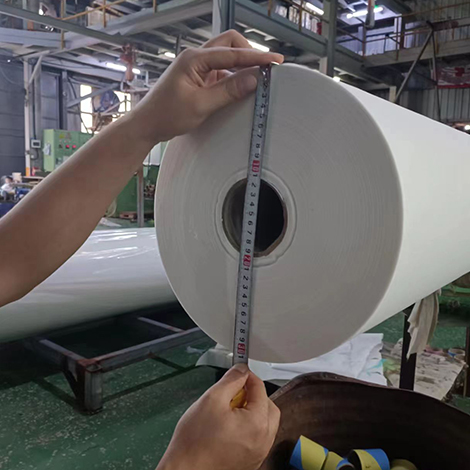
How to distinguish the quality of PP spunbond non-woven fabric?
October 23, 2026
The identification of the quality of PP spunbond non-woven fabric can be achieved through a three-layer method of "rapid hand eye screening+core indicator verification+professional testing", covering the entire process from visual recognition to compliance judgment, with low operational threshold and high accuracy:
1、 5-minute rapid hand eye screening
- Appearance uniformity: High quality products have uniform fiber distribution on the surface, without obvious cloud spots, holes, impurities or black spots, and there is no visible thickness difference from the edge to the middle of the entire width; Products produced from inferior recycled materials may have issues with local light transmission and fiber clumping.
- Touch texture to distinguish purity: The products produced from brand new pure materials have a fluffy and soft feel, without obvious plastic pungent odor; Poor quality products filled with a large amount of calcium carbonate have a hard and brittle texture. When rubbed, white powder will fall off, and a noticeable plastic odor can be smelled when approached.
- Simple tensile test: Tear along the longitudinal and transverse directions with bare hands. When tearing high-quality products, the resistance is uniform, and the broken edges are neat without a large amount of fiber shedding; Poor quality products break easily when torn, with a large amount of fibers flying off at the fracture site, and the tensile strength is much lower than the standard value for the same weight.
2、 Verification of core performance indicators
- Uniformity of weight: It is not enough to only sample and weigh at a single point. Samples should be taken at the edges, middle, and seams of the entire width, as well as at the head, middle, and tail sections of the coil. The weight deviation of high-quality products should be controlled within ± 3%, while the weight deviation of low-quality products at a single point can exceed 10%, which directly affects the overall tensile performance.
- Bidirectional Strength Compliance: Tested according to GB/T 24218.3 standard, the standard 40g/m ² product has a longitudinal fracture strength of ≥ 85N/5cm and a transverse strength of ≥ 72N/5cm, with a longitudinal and transverse tension difference controlled within 25% to be qualified; Poor quality products have a lateral tensile force that is less than 60% of the standard value, and they break when pulled.
- Breathability and thermal stability: Observing the pore distribution uniformly in front of a light source, there is no obvious local blockage in terms of breathability; Placed at 120 ℃ for 10 minutes, with a thermal shrinkage rate of ≤ 3.5% and no significant deformation shrinkage, suitable for high temperature scenarios such as medical sterilization.
3、 Final determination of compliance
- Medical and food contact products must have complete ISO and CE national standard testing reports verified to confirm that environmental indicators such as ethylene oxide residue and heavy metal precipitation fully comply with the mandatory standards for the corresponding scenarios.
- High demand orders require advance agreement on sampling point rules, weight tolerance range, and judgment caliber to avoid misjudging the overall quality of the roll through single point sampling. Wide width splicing products must be separately verified for weight and tension performance at the joints, which is the most easily overlooked quality weakness.
Contact us for samples or a quote:You can contact us anytime, and we look forward to working with you.
marketing@henghuanonwoven.com







 Network Supported