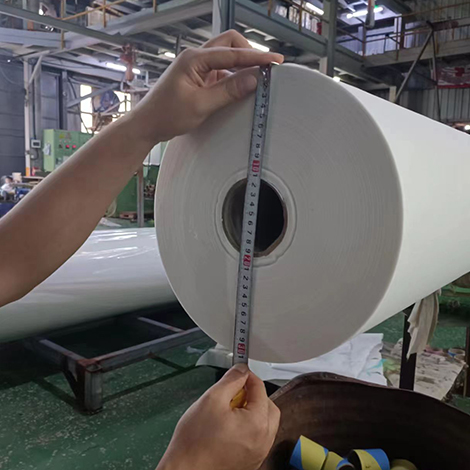

In a world that increasingly demands materials to do more with less, one champion consistently rises to the challenge: Polypropylene (PP) Spunbond Nonwoven. Often perceived as simple fabric, its true prowess lies in a remarkable paradox—it is exceptionally lightweight yet possesses surprising strength. This blog unravels the engineering behind this quiet power, explaining why PP Spunbond is the robust backbone of industries from healthcare to agriculture.
The strength of PP Spunbond is not an accident; it's engineered from the ground up. The magic happens in the highly controlled spunbond process:
This process creates a unified, matrix-like structure. Unlike woven fabrics made from twisted yarns, or wet-laid papers with short fibers, the continuous filaments in spunbond distribute stress evenly across the entire fabric. It's this integral one-piece construction that forms the foundation of its strength.
So, how do we measure this "might" in such a light material? Let's break down the key technical properties that define its performance:
| Property | What It Means | Why It Matters for PP Spunbond |
| High Tensile Strength | Resistance to breaking under tension or pulling force. | Ensures the fabric won't tear easily during production, installation, or use, even in wide formats (like our common 1.6m rolls). |
| Excellent Tear Resistance | Resistance to the propagation of a nick or cut. | Prevents small punctures or edge damages from ruining an entire piece of fabric, crucial for durability. |
| Low Specific Weight | The fabric achieves high strength at a very low weight per square meter (gsm). | A fabric like our 55gsm grade offers optimal strength for applications like masks, while remaining breathable and cost-effective. |
This "lightweight might" translates into tangible benefits across diverse sectors:
Agriculture & Geotextiles: As crop covers or weed barriers, PP Spunbond must withstand wind, rain, and UV exposure without degrading. Its strength ensures season-long protection, while its lightness makes it easy for farmers to deploy.
Medical & Hygiene: In surgical gowns, drapes, or mattress protectors, the fabric acts as a critical barrier. It must resist punctures and fluid penetration to ensure safety, all while keeping the wearer comfortable—a feat impossible with heavy, non-breathable materials.
Packaging & Furniture: Replacing heavier woven fabrics or plastics, strong PP Spunbond protects goods during shipping and provides a durable, breathable backing for furniture, enhancing longevity without adding weight.
Filtration: As a backing or support layer in filter media, the fabric's structural integrity under airflow pressure is essential for system efficiency and longevity.
The strength of PP Spunbond Nonwoven is a direct result of intelligent manufacturing—transforming a simple polymer into a network of continuously bonded filaments. This structure delivers reliable, consistent performance where it counts.
It proves that true strength isn't about bulk or weight; it's about smart engineering. For applications demanding a balance of durability, lightness, and cost-efficiency, PP Spunbond is not just an option—it's the mighty solution.
Ready to leverage the strength of lightweight PP Spunbond for your products? [Contact us] today to discuss your specific requirements and discover how our tailored nonwoven solutions can empower your next project.

Soclal sharing


E-mail : marketing@henghuanonwoven.com
Add : No.260 Liqi Road Hangcheng Street, Changle District, Fuzhou City, Fujian Province, China
Copyright @ 2026 Fuzhou Heng Hua New Material Co., Ltd. All Rights Reserved.  Network Supported
leave a message
Scan to Wechat :

Scan to WhatsApp :