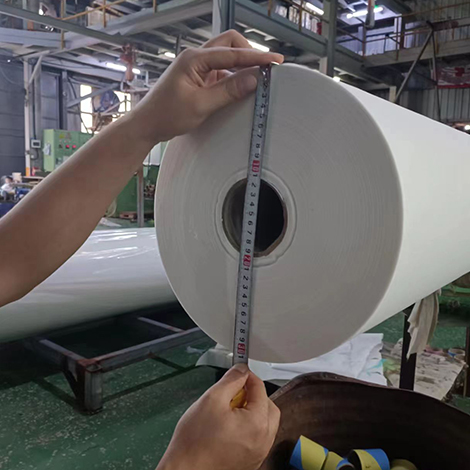
How to test the tensile strength of PP spunbond nonwoven fabric?
Nov 05, 2026
The tensile testing of PP spunbond nonwoven fabric must strictly follow the GB/T 24218.3-2010 strip method to obtain accurate and traceable results. The complete testing process and quality judgment method are as follows:
📋 Preparation before tensile testing of PP spunbond nonwoven fabric
1. Core equipment: The CRE electronic tensile machine with level 1 accuracy is selected, and the accuracy of the force sensor is better than ± 0.5% FS, with a range covering 10N~5kN, which is suitable for the testing needs of most conventional PP spunbond nonwoven fabrics.
2. Standard environment: put the sample in an environment of 20 ℃± 2 ℃ and 65% ± 4% relative humidity in advance to adjust the humidity balance for ≥ 24h to avoid 10%~20% error of test data caused by temperature and humidity deviation.
3. Sampling rules: Take samples along the longitudinal direction (MD, machine running direction) and transverse direction (CD, width direction) of the non-woven fabric, with the sampling position at least 1m away from the edge of the fabric, avoiding creases, holes, and oil stains. Cut at least 5 standard samples in each direction.
4. Sample specifications: Each sample size is 50mm wide by 200mm long. When cutting, ensure that there are no burrs or gaps on the edges to avoid stress concentration that may cause premature fracture of the sample.
🛠️ Standard Test Procedure for Tensile Strength of PP Spunbond Non woven Fabric
1. Preheat the tensile machine for 15-30 minutes, reset the force value and displacement data, set the clamping distance to 200mm, the stretching speed to 100mm/min ± 10mm/min, and apply an initial tension of 2N to the sample.
2. Use a fixture with rubber pads to clamp the two ends of the sample, ensuring that the sample does not slip or get pinched during the testing process. Start the equipment and stretch it at a constant speed until the sample is completely broken.
3. The equipment automatically records the maximum force value and fracture displacement during the stretching process. After each group of 5 samples is tested, the average longitudinal and transverse fracture strength and elongation at break are automatically calculated, and invalid data with obvious abnormalities are eliminated.
✅ Standard for determining the tensile strength of PP spunbond nonwoven fabric
1. Core indicators: Conventional 40g/㎡ civilian PP spunbond nonwoven fabric, with a qualified line of longitudinal breaking strength ≥ 85N/5cm, transverse breaking strength ≥ 72N/5cm, and elongation at break ≥ 25%; The 25g/㎡ mask special model has a vertical ≥ 85N/5cm and horizontal ≥ 72N/5cm, meeting the high-speed production requirements of automated mask machines.
2. Differentiation of advantages and disadvantages: The longitudinal and transverse tension difference of high-quality products is controlled within 25%, and the force is evenly distributed during the stretching process. The fracture edge is neat without a large amount of fiber scattering; Poor quality products have a lateral tensile force that is less than 60% of the standard value, and they break easily when torn. The fibers at the fracture point are heavily detached, which completely fails to meet the stress requirements of the usage scenario.
3. Special scenario supplement: High end products such as geotextiles and medical SMS composite fabrics require additional wet tensile testing (soaking in water at 20 ℃ for 1 hour and then draining the test). A wet strength retention rate of ≥ 90% is considered qualified, suitable for special scenarios such as water conservancy engineering and disinfection and sterilization.
Contact us for samples or a quote:You can contact us anytime, and we look forward to working with you.
marketing@henghuanonwoven.com







 Network Supported